


Article: Is Made to Order Jewelry Worth It? A 2026 Buying Guide
Is Made to Order Jewelry Worth It? A 2026 Buying Guide
Last Updated: October 23, 2026
Quick Summary
Yes, made to order jewelry is worth it when you value fit, materials, and a piece built for one person over the convenience of buying off a shelf. The trade-off is simple: you wait longer and you commit earlier.
- Made-to-order jewelry begins production only after you order, letting the maker adjust size, metal, and stone.
- Custom jewelry typically takes four to eight weeks from approved design to delivery.
- Ask for the written lead time and what happens if production runs late before paying a deposit.
- Producing after an order is placed avoids the overproduction that leaves unsold inventory behind.
- Ask for finished dimensions in millimeters, since a 6mm and 8mm band look identical on screen.
Table of Contents
- Is Made to Order Jewelry Worth It? The Honest Answer
- Made-to-Order vs Ready-Made Jewelry: What Actually Differs
- The Custom Jewelry Process, Step by Step
- How Long Does Custom Jewelry Take?
- Custom Jewelry Questions to Ask Before You Commit
- When Made-to-Order Jewelry Is Most Worth It
- Common Mistakes That Make Custom Jewelry Feel Not Worth It
- Conclusion
- Frequently Asked Questions
Is Made to Order Jewelry Worth It? The Honest Answer
Yes, made to order jewelry is worth it when you value fit, materials, and a piece built for one person over the convenience of buying off a shelf. The trade-off is simple: you wait longer and you commit earlier.
At Monsieur Moon, our entire workshop runs on this model, so we have a clear view of both sides. Every ring, pendant, and chain we make is shaped after an order is placed, not before. That changes what you get and what you give up.
Below, we break down the real differences between made-to-order and ready-made pieces, walk through the process step by step, and cover the questions worth asking before you commit. By the end, you will know whether this route fits your timeline and your budget.
Made-to-Order vs Ready-Made Jewelry: What Actually Differs
The core difference is when the piece is built. Ready-made jewelry is produced in batches and sits in inventory until someone buys it. Made-to-order jewelry begins production only after you order, which lets the maker adjust size, metal, and stone selection to your specifications.
That single change ripples through everything else: cost structure, timeline, and the amount of input you have.
Cost, Craftsmanship, and Timing Side by Side
Factor |
Made-to-Order |
Ready-Made |
|---|---|---|
Production start |
After your order |
Before your order |
Sizing |
Built to your measurement |
Fixed, may need resizing |
Metal and stone choice |
Selected by you |
Limited to what's in stock |
Lead time |
Typically several weeks |
Ships immediately |
Customization |
High |
None to minimal |
Resale flexibility |
Lower (personalized) |
Higher (standard sizes) |
Cost deserves a careful word. Made-to-order pieces are not automatically more expensive, but they are priced differently. You are paying for labor scheduled around your order rather than for inventory sitting in a case. Pricing depends on metal, stone, and complexity, so ask for a quote rather than assuming a figure.
Craftsmanship is where the gap widens. A bench jeweler working on a single piece can spend more time on setting and finishing than a production line can justify. Gemological Institute of America guide to jewelry quality factors explains how cut, clarity, and setting work affect a finished piece, which is useful context when you compare quotes.
The Custom Jewelry Process, Step by Step
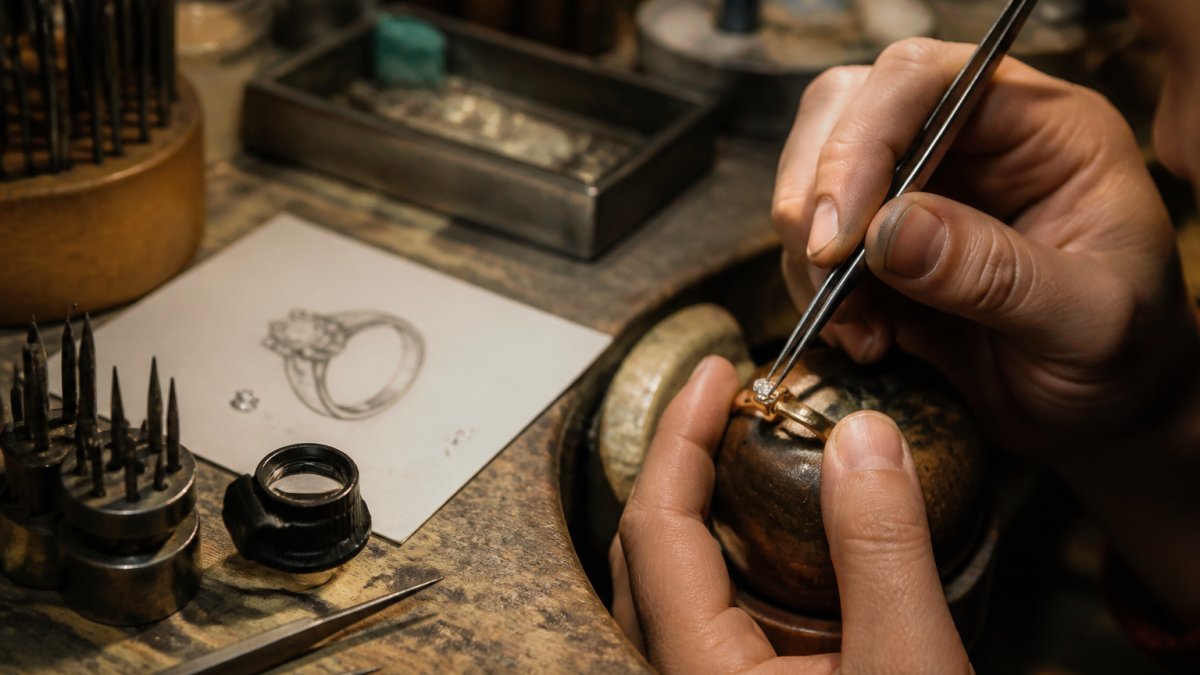
The custom jewelry process moves through five stages: consultation, design, quote and deposit, production, and final delivery. Each stage has a decision point where you approve before the next begins.
From First Sketch to Final Polish
- Consultation. You describe the piece, the occasion, and your budget range. Bring reference images and any existing jewelry whose fit you like.
- Design. The maker translates your notes into a sketch or rendering. This is your best chance to change proportions, stone shape, or band width before metal is cut.
- Quote and deposit. You receive a written quote covering metal, stones, and labor. Most workshops require a deposit to begin.
- Production. The piece is cast or fabricated, stones are set, and the surface is polished. Ask for a progress photo at the midpoint.
- Delivery and fit check. You receive the finished piece and confirm the fit. Resizing policies vary, so get yours in writing before you pay.
A common mistake is treating the design stage as a formality. What most guides miss is that proportion changes are nearly free on paper and expensive in metal. Spend your time there.
How Long Does Custom Jewelry Take?
Custom jewelry typically takes four to eight weeks from approved design to delivery, though simple bands can move faster and complex pieces with sourced stones can run longer. The design and quote stage adds another one to two weeks on top.
Timeline depends on three things: how complex the design is, whether stones must be sourced, and how busy the workshop is. A plain band in a standard metal is the fast case. A piece with a specific stone shape, engraving, or an unusual setting is the slow case.
If you are working toward a date, say so at the consultation. A proposal deadline is a hard constraint, and a good workshop will tell you honestly whether it can be met rather than take the order and hope.
Custom Jewelry Questions to Ask Before You Commit
Ask about fit, materials, timeline, and after-sale care before you pay a deposit. The answers tell you more about a workshop than any product photo will.
Use this checklist:
- What is the written lead time, and what happens if it runs late?
- Can the piece be resized later, and what does that involve?
- Which metals and stone grades are available, and what changes the quote?
- Will I see a rendering or progress photo before production finishes?
- What is the return or exchange policy on a personalized piece?
- Who handles repairs or refinishing after delivery?
- Is the piece hallmarked or stamped for metal purity?
That last item matters more than buyers expect. In the United States, the FTC Jewelry, Precious Metals, and Pewter Industries guides set out how precious metal content must be described and marked, so a reputable maker should be able to tell you exactly what a stamp means on your piece.
When Made-to-Order Jewelry Is Most Worth It
Made-to-order jewelry pays off most when the piece has to fit a specific person or a specific moment. Engagement rings, anniversary pieces, and anything built around an inherited stone are the clearest cases.
It is also the better route when standard sizing has failed you. A ring that never quite sat right, a chain length that was always slightly off, a pendant that felt too small in person: these are exactly the problems made-to-order solves.
There is a sustainability angle too. Producing after an order is placed avoids the overproduction that leaves unsold inventory behind, which is part of why U.S. Environmental Protection Agency materials and waste guidance keeps pointing buyers toward fewer, longer-lived purchases.
Where it is least worth it: a last-minute gift, a trend piece you may not wear for years, or a design you have not thought through. In those cases, ready-made wins.
Common Mistakes That Make Custom Jewelry Feel Not Worth It
Most disappointment with custom jewelry traces back to unclear expectations, not poor craftsmanship. Buyers who feel let down usually skipped a step that would have taken five minutes.
The recurring ones:
- Approving a sketch without checking scale. A rendering can make a stone look larger than it will on a finger. Ask for dimensions in millimeters.
- Choosing a trend over a design you actually love. A piece built for one season rarely survives a decade of wear.
- Not asking about resizing upfront. A ring that cannot be resized is a ring you may stop wearing.
- Comparing a custom quote to a mass-market price. They are not the same product, and the comparison will always feel unfair.
- Skipping the metal question. Two pieces that look identical online can differ entirely in what they are made of.
Conclusion
Deciding whether made to order jewelry is worth it comes down to your timeline and how much control you want over the finished piece. If you can plan ahead and care about fit, materials, and a design built for one person, the model delivers real value.
At Monsieur Moon, every piece is handcrafted in our New York studio after you order, using 14k and 10k gold, sterling silver, gemstones, and diamonds, both lab grown and mined. We welcome bespoke commissions, and our core collection includes customer favorites like the Caldera Ring and the Orion Ring, each rated 5.0 by buyers.
Start with a consultation, share your deadline, and we will tell you honestly what is possible. Add to cart when the design is right.
Frequently Asked Questions
What does made-to-order jewelry mean?
Made-to-order jewelry is crafted after you place your order, rather than pulled from a shelf of finished stock. The design is already set, but the piece is made for you in your chosen size and metal. That differs from full bespoke work, where you help shape the design itself. The upside is a piece made for you rather than sitting in inventory; the trade-off is a wait. Ask the jeweler whether sizing changes are included, since a made-to-order ring is built to your measurement.
Is made-to-order jewelry better quality than ready-made jewelry?
Quality depends on the maker, not the ordering model. Made-to-order pieces from a careful studio often get more hands-on attention per piece, and you can ask directly about metal purity, stone sourcing, and finishing. Ready-made jewelry can be excellent too, especially from makers with tight production standards. Judge both the same way: ask what the metal actually is, where the stones come from, and how the piece is finished. A made-to-order label alone proves nothing.
Can you return made-to-order jewelry?
Return policies vary, and made-to-order pieces often carry stricter terms than stock items because they were produced for you. Before you order, ask three things: the return window, whether resizing is free or paid, and what happens if the piece arrives damaged. Get the answer in writing. Reputable jewelers will state these terms clearly and will usually resize a ring that does not fit. If a shop is vague about returns on custom work, treat that as a warning sign.
How long does custom jewelry take, and what should I ask before ordering?
Timelines depend on the design, the metal, and the studio's queue, so ask for a specific production window rather than a general estimate. If you have a proposal or anniversary date, share it up front and confirm the piece will arrive with buffer time. Also ask whether sizing changes are included, what the guarantee covers, and how the jeweler handles repairs. A written timeline and clear answers to these custom jewelry questions to ask are the best protection for a significant purchase.

